28 May 2014

“Now on that same day two of them were going to a village called Emmaus, about seven miles from Jerusalem, and talking with each other about all these things that had happened. While they were talking and discussing, Jesus himself came near and went with them…” (Lk 24.13-15a)

On our last day in Jerusalem we were up early, leaving at 6 am for our Stations of the Cross journey. Carrying a cross, we followed the route Jesus would have taken from his trial to his burial. There were many other Christian groups going along the same journey. I found the experience very meaningful until we reached the last stations – Jesus’ crucifixion and burial. Because we are not Catholic we were not allowed to do those stations inside the Church of the Holy Sepulcher – the location of Jesus’ death and burial. Thus Protestant Christian groups complete those stations on the roof of the church. Something was lacking for me knowing the true sites were beneath me and as a Christian I was not allowed to worship at Christianity’s holiest site.

We have run  into this over and over – such and such a group has the rights for worship here and not others. The Muslims only allow Muslims to worship at the Dome of the Rock. However I find that fact that Christian groups prohibit other Christian groups from worshipping despicable.

We had about an hour free after we competed the stations. My friend and I made our way to the Western Wall. This has become a holy site for me, partly because the Jews welcome everyone, no matter your faith. It also seemed fitting to end the trip the way we began. I have found God at this wall.

The Western Wall was unusually crowded today. On the walk back to the school we came upon a road that was barricaded with about six Israeli soldiers standing in front of it. Many Muslim women were standing in front screaming. The soldiers were preventing access to the Dome of the Rock – the Muslim holy site. It turns out today is Jerusalem day and there are many more Jews in Jerusalem than usual. The Israelis on days like today close areas off to Muslims. Closing off their holy area makes things particularly tense. An example of how conflicting needs ratchet up tensions in this area.

After a late breakfast we went on to Emmaus (today Abu Ghosh) where we celebrated the risen Christ with Eucharist. Quite a contrast from the tension between the Muslims and the Jews.

We have completed our last field trip. Now to finish our shopping, and the shopping is good in Israel!

27 May 2014

We began today at an odd spot – the site of Jesus’ ascension from the Mount Of Olives. Interestingly, Islam also commemorates Jesus’ ascension.

At some point today we visited the Upper Room to commemorate the Last Supper but it was just too crowded. Here is a photo that shows the crowds we were dealing with.

photo (30)


Then we began our Holy Week at the spot on the Mount of Olives commemorating Palm Sunday and then proceeded to walk the now nicely paved Pilgrim Path leading down the hill.

photo (31)


We next stopped at a church commemorating the fact Jesus wept over the city of Jerusalem. This is the view he would have had from that spot. You can see the walls of the city. The gold dome is the Dome of the Rock which is where the Temple would have been sitting high above the walls of the city.

photo (32)


In order to walk to the city Jesus would have had to walk through the “valley of the shadow of death”- through a cemetery of many graves, many dating back to the 1st century.

Then it was onto the Garden of Gethsemane and the stunning Church of all Nations. Inside is a piece of ancient bedrock commemorating Jesus stopping there to pray.

photo (33)


From his arrest there he was taken into the city to the House of Caiaphas. These are 1st century steps Leading to Caiaphas’ house. Perhaps Jesus walked up these same steps.

photo (34)


The site also commemorates Peter’s betrayal of Jesus, and there is a wonderful statue of Peter and the three people to whom he betrayed Jesus. There is a rooster on top of the post in the statue.

photo (35)


Of course there is a church over the site, but the original dungeons are under the church. Jesus would have been lowered down through a hole cut in the rock. The dungeons is deep with about 40 foot high walls. Once in, there would be no way out.

And there we left Jesus. Whipped. Bloody. Semi conscious. In a dungeon. To wait.

26 May 2014

I want to tell you about our pattern of traveling. We get on the bus and arrive at a site. We gather and hear the pertinent story from the Bible. Then our chaplain gives a one to two minute reflection. Following a site orientation by our leader we are given some amount of time to explore the site on our own. Then we gather, load up, and drive to the next site. The only exception to this is when we are in the Old City of Jerusalem when we must walk everywhere. Our group is 40 and consists of about 1/2 clergy and 1/2 laity from US, Canada, Britain and Australia.

photo (29)
Icon over the altar at the Church of the Transfiguration

We began our last day in the Galilee at the same spot where Jesus ended his last day In the Galilee – on Mount Tabor, the site of the Transfiguration. Then we continued to follow Jesus’ footsteps back to Jerusalem, driving by , but not stopping at the village of Nain, where Jesus raised the widow’s son.

photo (27)

Jesus continued through Samaria stopping for water at Jacob’s well (where Jacob first saw Rachel.)

“Now when Jacob saw Rachel, the daughter of his mother’s brother Laban, and the sheep of his mother’s brother Laban, Jacob went up and rolled the stone from the well’s mouth, and watered the flock of his mother’s brother Laban.” (Gen 29.10)

We too stopped at Jacob’s well which is in the town of Nablus (in the OT this town is called Shechem and in the NT it is called Sychar). Nablus is in the West Bank. The well is there and reaches down to an underground spring.  Of course a church is built over the well now, and an elaborate iron structure is over it along with a modern bucket and pulley system by which the well reaches into the same water source as it did 3,500 years ago. Jesus met the Samaritan woman at the same well when he stopped there for a drink on his way to Jerusalem. We drank from the same water as Jacob and Jesus both drank.

From there we continued on Jesus’ journey to Jerusalem stopping in Bethany the home of Mary, Martha and Lazarus just six miles away from his final destination. Bethany is also in the West Bank and is now called Azariah.

“Jesus cried with a loud voice, “Lazarus, come out!” The dead man came out…” ( Jn 11.43b-44a)

photo (28)

The church built here is an active Greek Orthodox Church filled with simply fabulous icons. There was a stunning icon of the raising of Lazarus. We went inside what has been venerated as the tomb of Lazarus for centuries. It required quite a bit of gymnastics and limbo to get inside but we managed.

We are back in Jerusalem and tomorrow continue walking in Jesus’ footsteps on Palm Sunday.

25 May 2014

photo (22)

“When they had gone ashore, they saw a charcoal fire there, with fish on it, and bread…Jesus said to them, “Come and have breakfast.”” (Jn 21.9, 12a)

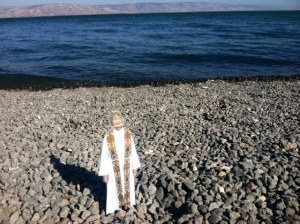
I love the Sea of Galilee! We spent the bulk of the day here and went to the location where Jesus made a resurrection appearance to the disciples on the shore, cooking them breakfast. (Above:  On the beach at the Sea of Galilee at the site of Jesus’ post-resurrection appearance to his disciples.)

We also took a boat ride in a larger replica of a 1st century fishing boat.

Downloads

It was glorious being out on the sea. We got to see a demonstration of fishing with a 1st century style casting net.

This is a wonderful place for Jesus to have based his ministry. It puts some distance between him and the Romans and allowed him freedom in a serene space to gather enough followers to head to Jerusalem.

Earlier in the day we made a very quick trip to the Mount of Transfiguration and a longer trip to Caesarea Phillipi. This is  the place where Peter proclaimed Jesus as the Messiah and where Jesus named him Peter and proclaimed him as the rock upon which he would build his church. It is very interesting that Jesus went to Caesarea Phillipi and chose this as the location to ask “Who do you say that I am?” It is at Caesarea Phillipi that King Herod built a temple to Emperor Augustus – its remains still stand today.

Caesarea Phillip is in the Golan Heights from which one can see both Syria and Lebanon. We could see the UN Peacekeepers base and old Army posts and tanks.

photo (25)
Golan Heights- mountains in distance are Syria.

Once we came back to our guesthouse, a large group of us took a swim in the Galilee and had a marvelous time playing and laughing. I could just imagine Jesus and his hot, sweaty, tired disciples jumping in to cool off and enjoy some recreation after a long day.

We finished the day with Eucharist. Although the picture is dark, you should be able to make out the altar and our view as we celebrated our last Sunday in Israel.

photo (26)

We have one more day in Galilee and it’s back to Jerusalem tomorrow night.

24 May 2014

photo (18)

We are in Galilee. I know why Jesus decided to stay here for 3 years. It’s gorgeous! Serene. I can imagine him working his way up from Nazareth (and we are quite a distance from Nazareth), finding the Sea and thinking “I think I will stay awhile.”  I feel like I’m on vacation from a vacation. Amazingly the Galilee region is not built up much at all.

We started in Capernaum and saw the remains of Peter’s house where Jesus lived for 3 years. It is small ,and Peter, his wife, his mother-in-law, some kids and Jesus in it and wow! Tight quarters.

photo (19)
Peter’s house is the small structure on top of the larger one.

We went to the sight of the healing if the demoniac where the demons went into the swine and then to Bethsaida – the site of the healing of the blind man and the feeding of the 5,000.

photo (21)

For lunch we ate St. Peter’s fish –  from the tilapia family. We are staying at a German retreat house. And I swam in the Sea of Galilee!

photo (20)
Look! FLAN is walking on water on the Sea of Galilee!

23 May 2014

But the angel said to the women, “Do not be afraid; I know that you are looking for Jesus who was crucified. He is not here; for he has been raised…” (Mt 28.5-6a)

photo (16)
The view of the Old City of Jerusalem from the Garden of Gethsemane. Jesus would have seen this, though the gate would not had been plastered closed.
photo (14)

This morning the woman who came with me and I started walking into the Old City at 5:30 am to beat the crowds to the Church of the Holy Sepulcher. (At left: Crosses carved centuries ago into the stone walls at Church of the Holy Sepulcher by pilgrims.)

This church is built over the sites of Jesus’ crucifixion and burial. Many different Christian faiths have chapels in the church, but the main areas are Greek Orthodox. There were two services going on when we got there – Greek Orthodox and Roman Catholic – but most of the church was empty. We didn’t have to wait at all to get to Calvary, which is in the upper level of the church. You can see the stone upon which Jesus was crucified and actually touch the spot. On the lower level of the church you can see how the stone is split in a vertical line downward from the spot where Jesus’ cross was.

photo (13)

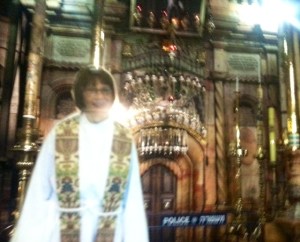
We waited 1/2 hour for the tomb to be opened. A monstrous structure has been built over the tomb. You enter an outer room where a piece of the stone the angel moved is there. Then you enter the tomb. It is small-about 6×4 and only 2 or 3 people can be in there at once. I actually found the tomb more moving than the crucifixion site. (Above:  Standing before the structure that houses the tomb of Christ.)

Are these the sites historical?  They seem pretty sure they are, as Christians have been worshipping at these sites since the first century. So in my mind they probably are the true sites. At the very least they are holy sites due to the millions of Christians who have come here over the centuries to remember and to worship.

We also went to the Garden of Gethsemane. The church there was closed as they are preparing for the Pope, but we saw the garden. The olive trees there are said to date to the time of Christ! Imagine if he prayed among those very trees!

photo (15)
An ancient olive tree in the Garden of Gethsemane

We made another trip tothe Western Wall. When I asked for guidance I heard the word “Rest.” And that is what I am doing this afternoon. I skipped our afternoon tour to rest and to stop.

I have many stones from various places for our labyrinth, including a number of shards of pottery that date to before the time of Christ.

photo (17)
Street in the Old City at 5:30 am. Each of those shops is crammed with merchandise when they are open and there is a maze of alleys just like this throughout the Old City.

Since it’s Friday and the Jewish Shabbat begins tonight, they are selling freshly baked challah bread in the bakeries. Our gelato place is closed today since it’s the Muslim sabbath. Muslim shops are closed on Friday; Jewish shops on Saturday and Christian on Sunday. It’s hard to keep straight! At least they take Sabbath!

The Pope arrives tomorrow and we are getting out of town – to the Galilee for three days.

22 May 2014

photo (12)
Wall dividing West Bank and Israel

We spent the day in Samaria, in Palestine, in the West Bank. This was not the first time we have been to Palestine, but it was the first time we have delved into 21st century life in Palestine. We spent the morning with an Anglican priest, an Arab Christian, who told us of the work of his church.

In our press the Palestinians are portrayed as the bad guys and the Israelis as the good guys. The reality is not so simple. It’s not black and white but many shades of grey. I think the reason there is no peace is because neither side really wants it. They each just want the other out. As you go through the checkpoint into Palestine there is a sign that says no Israelis allowed. Enter for fear of your life. A sign threatening Palestinians is visible as you return to Israel. Even now as we return to the college we encounter a make-shift checkpoint in a stretch of highway.  As the woman who is traveling with me said, “They are each so busy trying to one-up the other that there can be no reconciliation.”

There is no easy answer. Several things are clear to me, though. One: the situation is not as clear-cut as portrayed in the media. Both the Israelis and the Palestinians have valid complaints and valid needs. Both make the situation difficult. Two: Ordinary Palestinians like you and me have a very tough life. Three: I take my freedoms for granted–freedom to worship how, where and who I choose; freedom to live and work where I choose; freedom to travel and move around as I choose; freedom to read what I choose; and freedom to say whatever I choose. Many are not so fortunate.

21 May 2014

“And Jesus entered the temple and began to drive out those who were selling and those who were buying in the temple, and he overturned the tables of the money changers and the seats of those who sold doves..”  (Mk 11.15b)

QLL

We began today very early, leaving at 6:30 am for the Western Wall (formerly called the Wailing Wall). There were a lot of people there early! One must go through security to enter the area. This wall is a remaining wall from the Second Temple – the temple completed by King Herod and dedicated in 10 BCE. The stones are gigantic. Look at how small the people in the picture are in comparison to the wall. When I stood at the wall, the first block stopped at heart level. (Below: Stone from the Second Temple)

This site is a holy site for the Jews and is open for prayer 24 hours/day. The men pray on one side and the women on another. This was my second visit. I find it a powerful place. There is a special energy there generated by all of the people in prayer. It was almost as if the stones are living. The energy is palpable. I wonder, if we had a place set aside for prayer if anyone would come.

From there we waited in line 45 mins to go through security again at the non-Muslim entrance to the Temple Mount. This is a Muslim holy site – The Dome of the Rock, built in 691 CE, sits at the spot of the former Jewish temple. It is supposedly over the rock where Abraham almost sacrificed Isaac. Jews and Christians are not allowed to pray there or to bring any symbols of their faith. We saw many groups of Muslim men and one large group Muslim women studying together.

The Temple Mount is huge – covering 34 acres. The area surrounding what would have been the Temple is so big that Jesus would only have chosen a small section to clear the money changers from. I always thought he cleared the entire space. That would not have been possible.

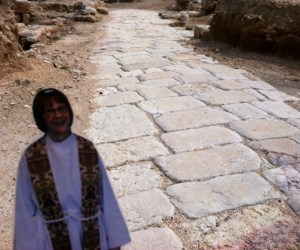
Later we stood on first century stones in the city. Perhaps Jesus, or the disciples, stood there. We also saw stones from the Second Temple that lay where they fell after the Romans  destroyed the temple.

photo (10)

We saw the pool of Bethzatha where Jesus cured the paralytic. I believe that was the true location. What I do not believe are the number of places where Mary was born -sort of like “Washington slept here.”

There are soldiers everywhere. We are used to seeing soldiers carting Uzis in the shopping area and even at the beach.

On Fridays a siren sounds at sunset letting the Jews know Shabbat has begun. They stop work and begin their observance of the Sabbath. It makes me wonder – what if we set an alarm to tell us our Sabbath had begun – even if only an hour? Or are we too busy to try?

20 May 2014

photo (1)
The Dead Sea. The white is salt and that land used to be underwater.
photo (3)
Remains at Masada.

Today we went to Masada, which is a mountain (1280 ft above the Dead Sea) in the desert on the Dead Sea. King Herod the Great built palaces on the site (1 huge one for him & 1 for each of this wives) between 37 -31 BCE. Amazingly many original remains are still standing. King Herod like the good life – he had baths, a steam room, mosaics and frescos.

In 66 CE 964 Jews moved to Masada. After the fall of Jerusalem to the Romans these Jews remained. The Romans sent 6,000 soldiers to oust them. The Jews killed themselves rather than become Roman slaves.

Masada was so hot. I don’t know how the folks survived there depending only upon rain water because it doesn’t rain much in the desert. The Romans devised an elaborate, ingenious  system to get water up the mountain.

Although Masada is in the desert, it was strangely beautiful. And the view of the Dead Sea is stunning.

photo (6)

Then we went to Qumran where we saw the ruins of the Essene community there and also saw the caves where the Dead Sea Scrolls were found. It was a good follow on to our visit to the museum the other day.

photo (7)
Cave at Qumran where first Dead Sea scrolls were found

Then we went to the Dead Sea – the lowest point on earth (1,400 ft below sea level).  The Dead Sea is huge – although a lot smaller than it used to be – and beautiful. You would never guess by looking at it nothing can live there. We floated in it! It was awesome. You sit down like you are sitting in a chair and your feet pop up! Truly. You just are held up with no work required on your part at all. A great end to a hot day.

photo (4)
photo (5)
The end of the Dead Sea

19 May 2014

photo (2)
Jesus would have walked over hills like these from Nazareth.

We started the day early with a 2-hour bus ride up to Sepphoris, which was during Jesus’ time a Roman city of about 60,000. Sepphoris is only 3 miles from Nazareth. Jesus and his family probably went there, perhaps to the large market. Perhaps Joseph, and maybe Jesus,  went there to work.

photo

Extensive archeological excavations are ongoing that have uncovered 1st century ruins. We stood at the crossroad of the two major streets in town – 1st century Roman streets. The roads even have 1st century graffiti!

photo (1)

This was the first 1st century site we have seen that did not have a modern building built over it. I felt much more connected to the incarnate God who walked the earth along with a more powerful sense of what the incarnation means. It was awesome!

The ruins are remarkably well preserved. We saw a wonderful mikvah (place for ritual bathing) in a priest’s 1st century home.

photo (18)
Mikvah

Then lunch in Nazareth. By the way, I really don’t like Middle Eastern food at home but I like it here. They use very little garlic so you can actually taste the flavor of the food. For example the other day we watched a chef make hummus. He made a huge batch for 50 people and used only one clove of garlic. And the spice shops here are amazing !  I plan on bringing some spices home.

In Nazareth we first went the the Church of the Annunciation (honoring the Angel Gabriel
Coming to Mary.) The annunciation occurred in – get ready – a grotto! seems a lot of important things happened in grottos. I  accidentally deleted the picture from my phone so I don’t have one to show you. ( I have some on my camera).

photo (4)

Then we visited the Sisters of the Nazarene. Under their house were found 1st century ruins. We saw part of a 1st century house with the original dirt floor. We also saw a 1st century tomb that is like the one where Jesus was buried. There is an area for preparing the body along with several places for bodies and a round stone. It is all there. The opening and stone are smaller than I expected. I would say the stone is about 3 1/2 feet high. I had to kneel in order to look into the opening.

It was a long – and good – day.